The importance of flying the Sacred Heart Flag
There is a centuries old tradition of flying flags, combining religious and national symbolism. Many flags used by nations today have their roots in the Christian tradition.
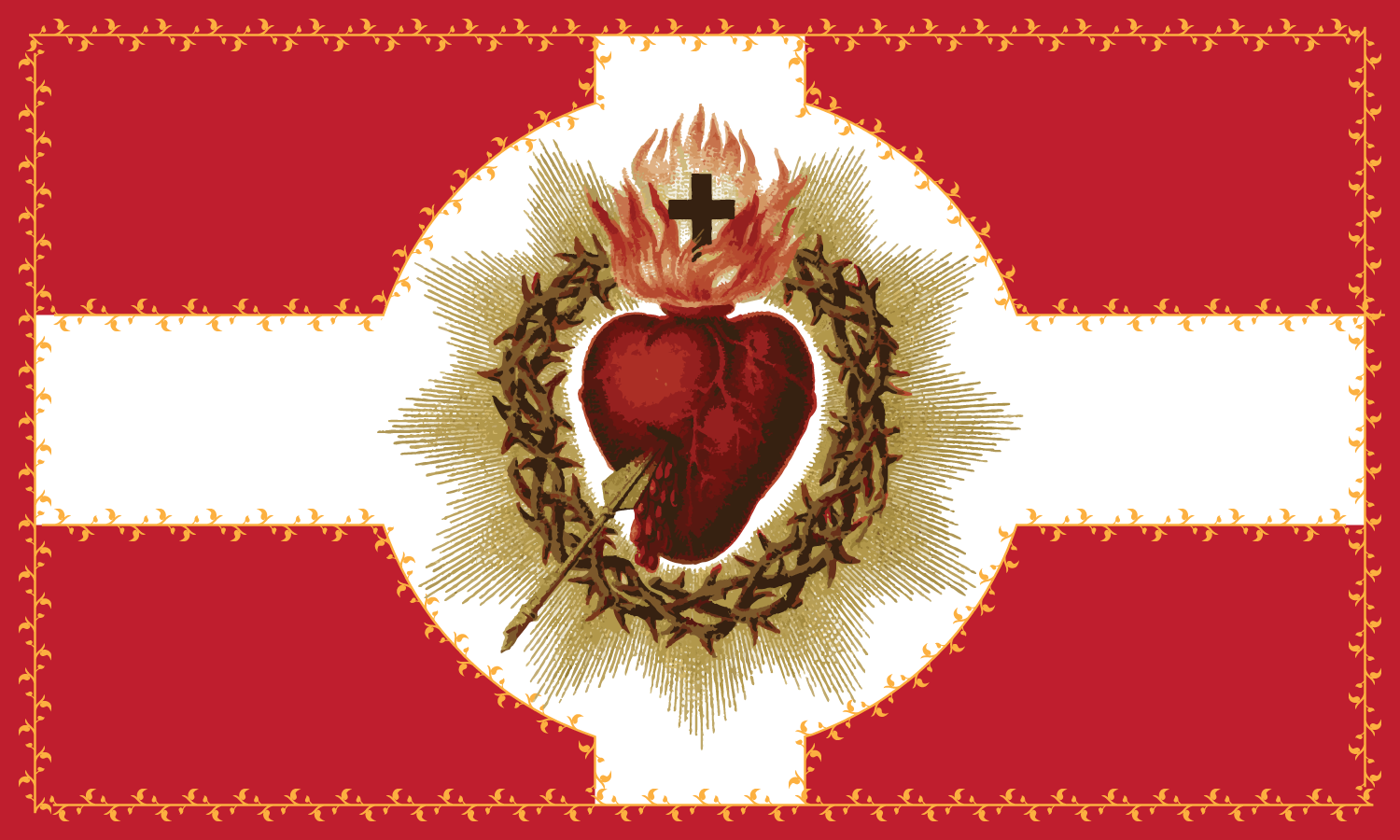
Symbolism is powerful. The symbol of the burning Sacred Heart of Jesus depicted on the Sacred Heart flag represents the burning love Jesus has for every person.
What greater symbol is there to unite all peoples under this universal banner of inclusive love?
The Sacred Heart imagery, with the burning heart and the crown of thorns has a profound impact in the hearts of the faithful. This powerful symbolic imagery does not only resonate with Catholics, but also with other Christian denominations. It unites all peoples of faith under the shadow of its banner.
Saint Joan of Arc and Sister Margaret Mary Alacoque, Apostle of Devotion to the Sacred Heart
Devotion to the Sacred Heart is as old as Christianity itself. Indeed many of the great mystics of the Middle Ages were inspired by the burning love Jesus has for souls.
The earliest recorded devotions to the Sacred Heart of Jesus date back to the 11th and 12th centuries. Imagery of the Sacred Heart, which also included the five wounds of Jesus, originate from 15th Century.
Saint Joan of Arc (1412–1431) was a French military leader who was burned at the stake for heresy in 1431. Medals and other religious art feature both Saint Joan of Arc and the Sacred Heart of Jesus. She is the patron saint of France, soldiers, and prisoners, canonised by Pope Benedict XV in 1920.
Although not the first to do so, Sister Margaret Mary Alacoque (1647-1690) was a French Visitation nun and mystic who promoted devotion to the Sacred Heart of Jesus.
Jesus appeared to her and showed Margaret his heart. He told her to promote devotional practices.
These practices consist of receiving Communion on nine consecutive First Fridays of the month, praying a holy hour on the eve of a first Friday, and celebrating a feast in honour of the Sacred Heart on the Friday after Corpus Christi.
Jesus also told her people should pray to him under the title of the Sacred Heart and to offer reparations for sins committed against God.
75 years after her death in 1765 her visions were officially approved by Pope Clement VIII. Along with Joan of Arc, Sister Mary was also canonised by Pope Benedict XV in 1920.
Sister Margaret Mary always kept a Sacred Heart badge with her and encouraged her novices to do the same. About thirty years after her death Marseilles was ravaged with a plague with thousands dying daily. The Bishop of the city asked the nuns to make thousands of badges and he led a procession to the centre of the city. Marseilles was dedicated to the Sacred Heart and from that moment not one case of the plague was reported.
The badge was worn by Catholic leaders and heroes during the French Revolution where many Catholics found protection from anti-Catholic persecution by wearing the badge.
Among the belongings of Marie Antoinette there was found a drawing of the Sacred Heart with the wound, cross, and crown of thorns and the inscription “Sacred Heart of Jesus have mercy on us!”
The Sacred Heart badge has been used as a protective amulet since the 17th century. It has been worn by Catholics during plagues, persecutions and wars. E.g. during the fight against Napoleon’s army in the Tyrol, Austria.
Many countries have taken up these devotions. For example, in 1873 on Passion Sunday, all the people of Ireland including all the Bishops solemnly consecrated themselves and their country to the Sacred Heart, to place God back at the centre of the Nation.
Spanish soldiers in the 18th century wore badges with the phrase “detente bala” which means “Stop bullet”. It was worn by soldiers during the anti-catholic Spanish Civil War. The whole motto is usually written “Detente bala, el Corazon de Jesús está conmigo!” meaning: “Stop, bullet, Jesus Christ Sacred Heart is with me (or protects me)!”
Other countries, which have participated in some fashion, include France, Germany, Italy, Spain, Cuba and Mexico. Catholic Cubans wore the badge when facing executioners.
The flying of the Sacred Heart Flag in the context of a prayerful procession, flown for many hundreds of years, is a collective action of community solidarity, which unites, consoles and embraces.
We close with a beautiful prayer by Blessed Pope Pius IX (1846-1878):
Open Thy Sacred Heart O Jesus! Show me It’s beauty and unite me with It forever. May the throbbing in all the movements of my heart, even during sleep, be a testimony of my love and tell Thee unceasingly: Yes, Lord Jesus, I adore Thee … accept my poor little actions … grant me the grace of repairing evil done … so that I may praise Thee in time and bless Thee for all eternity.
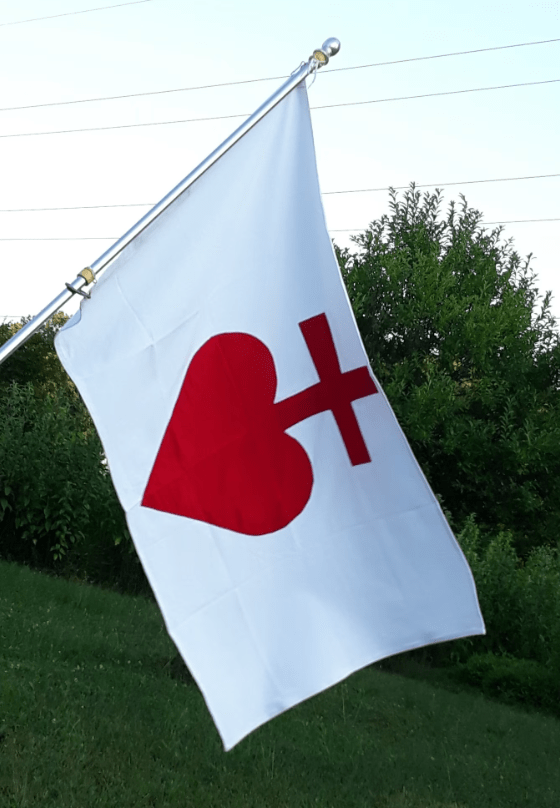
A Variety of Flags of the Sacred Heart of Jesus


 Sacred Heart 24